Home remedies for Obesity - Ayurveda Health tips

Tips: Home remedies for Obesity
  •     Spices like dry ginger, cinnamon, black pepper etc are good for losing weight.
  •     Regular intake of carrot juice.
  •     Vegetables like bitter gourd (kerala) and bitter variety of drumstick are useful in losing weight.
  •    Honey is an excellent home remedy for obesity. It mobilises the extra deposited fat in the body.

The Malas


Malas  are the various waste products of the  dhatus  produced during the normal metabolical process. The three primary malas being  Purisa (faeces),  Mutra (urine) and  Sweda  (sweat).  Ayurveda clearly states that only a balanced condition of doshas,  dhatus and  malas  is  arogya (good health or disease free condition) and their imbalance is the cause of ill health or disease.

Purisa is the waste left back after nutrients of digested food have been absorbed in the small intestine. While water and salt absorbed in the large intestine, the residue now converted into solid faeces, leaves the body. The consistency of the faeces depending both on gastrointestinal mobility and nature of diet.

The Dhatus

The  Sapta (seven)  Dhatus (tissues) elements form the pillars of the body that form the means of nourishment and growth while providing support to the body as well as the mind.

Rasa (fluid) Dhatu –Derived from the digested food, it nourishes each and every tissue and cell of the body and is analogous to the plasma.

Rakta (blood) Dhatu – Regarded as the basic of life, it is analogous to the circulating blood cells. It not only nourishes the body tissues, but provides physical strength and colour to the body.

Agni


Being the biological fire that governs metabolism,  agni  encompasses all the changes in the body and mind from the dense to the more subtle. Such changes include the digestion and absorption of food, cellular transformations, assimilation of sensory perceptions and mental and emotional experiences.  Agni  therefore covers whole sequences of chemical interactions and changes in the body and mind. Digestive abilities being related to the strength of agni.

The Trigunas


Just as the  doshas are the essential components of the body, the three  gunas  - Satwa,  Rajas and  Tamas  - are the three essential components or energies of the mind. Ayurveda provides a distinct description of people on the basis of their  Manasa  (psychological)  Prakriti (constitution). Genetically determined, these psychological characteristics are dependent on the relative dominance of the three gunas.

The Tridoshas

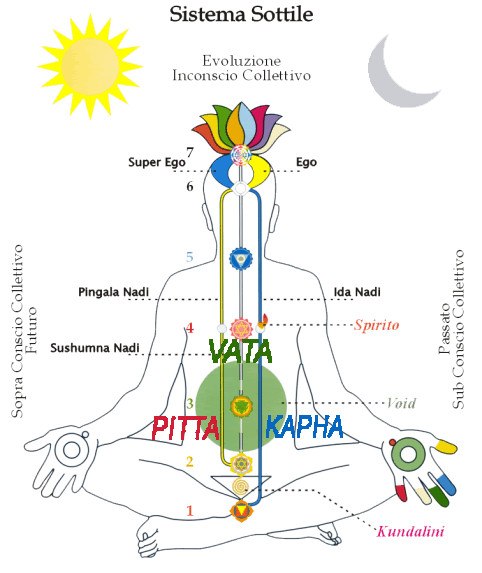
The Tridoshas (three doshas) are considered as the primary and essential factors of the human body. It governs our entire physical structure and function. The word ‘tri’ refers to ‘three’ and the term ‘doshas’ refers to the basic physical energies. Dosha, derived from the Panchmahabhutas, is a combination of any two of the five bhutas with the predominance of one.  Dosha are like the elements that cannot be detected with our senses but their qualities can be.

The Panchamahabhutas


According to Ayurveda everything in life is composed of the Panchamahabhutas – Akash (Space), Vayu (Air), Jal (Water), Agni (Fire) and Prithvi (Earth). Omnipresent, they are mixed in an infinite variety of relative proportions such that each form of matter is distinctly unique. Although each element has a range of attributes, only some get evident in particular situations. Constantly changing and interacting with each other, they create a situation of dynamic flux that keeps the world going.

Principles of Ayurveda

Ayurveda explains an individual bundle of `spirit’ (desirous of expressing itself) utilizes Satwa (subjective consciousness) to manifest sense organs and a mind. Spirit and mind then combined together into a physical body. The five great eternal elements create the physical body. And these elements are Panchamahabhutas (Pancha = five; maha = great; bhutas =elements), which form from Tamas. The sense organs then use Rajas to project from the body into the external world to experience their objects. The body becomes the mind’s vehicle, its physical instrument for sense gratification.

 
Page Top